

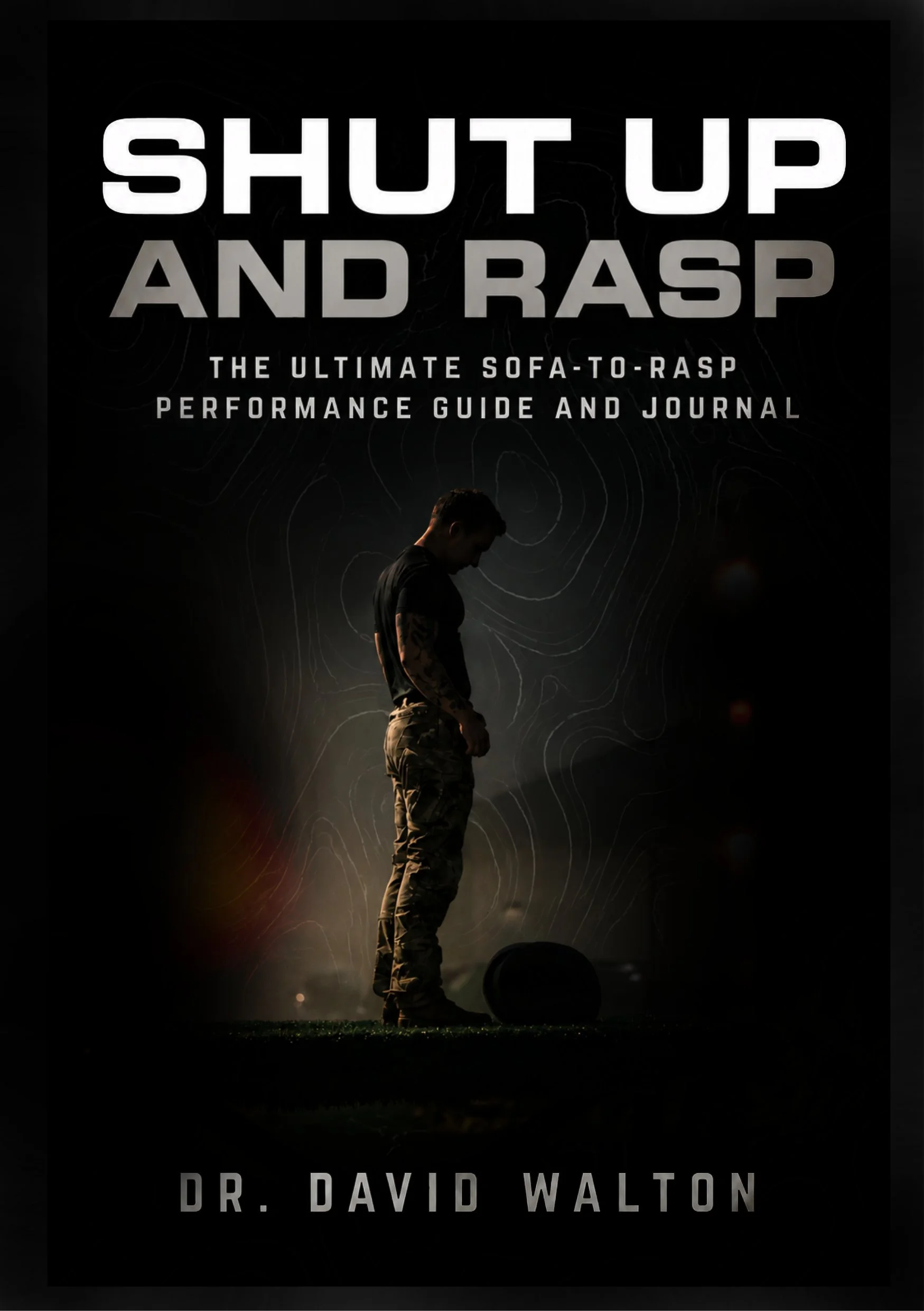
SHUT UP
AND RASP
THE ULTIMATE SOFA-TO-RASP PERFORMANCE GUIDE
AND JOURNAL FOR ASPIRING RANGERS
Rangers Eat Their Young
It’s not a motivational quip or a critique on unit culture. It’s a simple statement of fact. Rangers eat their young. This doesn’t appear on any Regimental letterhead or T-shirt. You won’t likely hear it from any senior leaders, at least not out loud. But you need to understand this immutable fact as you begin your quest through RASP and into the 75th Ranger Regiment, because the sentiment will define your early existence more than anything else. You are going to be fighting for your life, every single day, and at every single event your entire time in the Regiment. You are expendable and you will be given no quarter. Nobody gets special treatment, even the Regimental Commander. And that’s a good thing. Let me explain.
The 75th Ranger Regiment is the world’s premiere light infantry force, but they do so much more than just light infantry stuff. Their assessment and selection process reflects this operational reality. The modern 75th Ranger Regiment traces its lineage to earlier American Ranger formations, but its current organization began when the Army activated 1st Ranger Battalion in July 1974 and 2nd Ranger Battalion in October 1974 under Army Chief of Staff Gen. Creighton Abrams. Following the Rangers’ performance in Grenada, the Army activated 3rd Ranger Battalion and the regimental headquarters on October 3, 1984, creating the organization that became formally designated the 75th Ranger Regiment in 1986. Since then, the Regiment has served in every major U.S. conflict from Panama and Somalia through Afghanistan, Iraq, and Syria.
Most people think that the Ranger Regiment just does Airfield Seizures, what we now call Joint Forcible Entry or JFE, and some Direct Action Raids. They do these things, but they do a bunch of other stuff as well. A bunch of other stuff. Unless you are in the know then you simply don’t know, and most people have no idea. And they are growing. In the summer of 2026, the Army announced that the Ranger Regiment was adding a fourth “maneuver battalion”, adding to its Special Troop Battalion (STB) and Regimental Military Intelligence Battalion (RMIB) growth from the early 2000’s. With the exception of aviation assets, the 75th Ranger Regiment has every battlefield function you could want. It is frightfully lethal.
Early Ranger assessment and selection was called the Ranger Indoctrination Program (RIP) and was developed alongside the rebirth of the Ranger battalions in the 1970s. Early versions were run at the battalion level. 1st Ranger Battalion established an organized indoctrination/selection process in the mid-1970s, with 2nd Battalion subsequently adopting its own program. As the Regiment consolidated, RIP became a centralized regimental program at Fort Benning in 1985, creating a common standard for enlisted Soldiers entering the Ranger Regiment. The classic RIP was a relatively short, physically punishing course. Generally, three to four weeks depending on the period and designed primarily to determine whether a Soldier possessed the fitness, discipline, motivation, and basic skills required to enter a Ranger battalion. Put succinctly it was a fucking smoke-fest. Absolutely brutal and a real rite of passage.
During the wars in Iraq and Afghanistan, however, the Regiment concluded that RIP did not provide enough time to thoroughly assess candidates or prepare them for the operational demands of arriving at a unit that might deploy almost immediately. In 2009 the Regiment began redesigning RIP and the separate Ranger Orientation Program (ROP) used for senior NCOs and officers into the Ranger Assessment and Selection Program (RASP). The transition occurred in late 2009, with RASP 1 formally replacing RIP in January 2010. RASP 1 doubled the enlisted pipeline to approximately eight weeks and placed considerably greater emphasis on both assessment and preparation for service in the Regiment. At the same time, RASP 2 replaced ROP as the assessment and selection program for senior NCOs, warrant officers, and commissioned officers.
Note that this high barrier to entry isn’t just for young Privates. It’s for every single person, assaulter to support, commander to cook. You either meet the standard or you don’t get to serve. This is even true if you are already in the Ranger Regiment in some positions and you want to promote up. You have to go back through RASP 2 and recertify. I can only imagine the gnashing of teeth and wailing of tears if we did that in Special Forces. That’s a concept that I can get behind. No tab wearers, only tab bearers. In this case scrolls. This mantra that “everyone must meet the standard, no exceptions” is central to the Regiment’s culture and it’s what feeds the “eat the young” zeitgeist.
Modern RASP is a little less mindlessly brutal than RIP was, but not by much, and the sentiment that you are expendable is still very much present. One popular sentiment that is often repeated is, “We aren’t trying to train you. We are trying to kill you.” That’s not technically true, but it is true in spirit. And it’s this mentality that dominates the culture. Incredibly professional, highly skilled, but always on the edge of dangerous. Thank God that the 75th Ranger Regiment exists and double thanks that this spartan mindset still exists. No matter how modern our warfare becomes, the grunt in the mud and his unyielding determination to suffer and win will always be the determining factor in victory or defeat. You will learn to suffer, but not mindlessly.
So, our programming in this book will acknowledge the reality of the operational environment with its unyielding standards and austere and demanding conditions. But even the Ranger Regiment acknowledges that most important of SOF Truths: Humans are more important than hardware. So even if they say they’re trying to kill you, and it will often feel that way, RASP is actually a very finely tuned machine with a delicate balance of brutal performance, nuanced assessments, and an outcome that befits the finest light infantry fighting force the world has ever seen. Shut Up and RASP will help you prepare for that reality without killing you. It may feel like impending death in the moment, but if you trust the process and remain consistently dedicated to the programming then you just might have what it takes to be called a Ranger.
Why did I write this book?
Same two reasons as always. Misinformation, and something I owe.
There is a fair chance that you found this book through my other works, which focus on Special Forces Assessment and Selection. I am an expert in SFAS. I know less about RASP, but not nothing. I am an expert researcher. I have an advanced degree in research, and I can pull together a complex and comprehensive research project better than most. And because I have a deep understanding of military culture, organizational nuances, and human dynamics I’m well-positioned to evaluate RASP. One of the things that my research has revealed is just how much the popular culture and conventional wisdom has gotten wrong about RASP and RASP prep. Even from those that have attended. We went beyond that superficial stuff and got into the actual data.
Ranger Assessment and Selection Program has the same problem SFAS has always had, and it's the same problem every hard, exclusive pipeline in this profession has. The guys who make it don't say much about it. The guys who don't make it say plenty. 50% of the young Infantrymen who show up to RASP don't graduate to the Regiment, and every single one of them goes to a unit, a gym, a group chat, or a comment section and starts talking. Some of them are honest about it. A lot of them aren't, because nobody wants to tell his little brother or his platoon or a stranger on the internet that he just wasn't good enough that cycle. So the story gets softened. The standard becomes "arbitrary." The cadre become "political." The guy who got dropped for a physical standard becomes, three retellings later, a guy who "got screwed because of his tattoos" or "because his squad leader had it out for him." I've heard versions of every one of these about SFAS for nearly three decades. I'd be shocked if RASP is any different, and a few hours on the forums and comment sections tells me it isn't.
Here's the part that should bother you more than it bothers most people: there's no organized counter-narrative. Nobody from Benning or Moore is running a public information campaign to correct the record, and I don't fault them for that, screening is supposed to stay a little opaque. But into that vacuum walks every podcast bro with a "Ranger prep" playlist and zero verifiable connection to the actual program, every forum thread of guys who heard from a guy, and every dropout with a grudge and a following. Most of it is garbage. None of those guys or that stuff follows the evidence. Some of it is dangerous garbage, the kind that gets a kid injured trying to simulate misery nobody in the Regiment asked him to simulate. This book exists to put something better into that vacuum. Not a leak, not an inside track, just the actual current standards, the actual current research, and a program built honestly on both. That will deal with the misinformation part.
The “something I owe” part is simpler to explain than it is to earn. Not to be too corny, but I am an American. A proud American. An honest to God mom, baseball, and apple pie American who proudly waves the flag every chance I get. And with decades of service to this great Nation, I understand how important it is that we continue the proud tradition of an all-volunteer force that will fight and win our Nation’s wars. In order to do that we need meat-eaters. Skin-your-knees, drink-from-a-dirty-hose, rub-some-dirt-on-it meat eaters who are capable of extreme violence, but on a very finely tuned trigger. This is something that modern society is not producing in the quantities that we want. In an age of failing fathers, institutional malaise, and societal pussification, I’m serving up a little tough love, clear messaging, and direct action. I feel like I have a duty to provide what I can from my expertise and experience. Eat the fucking meat and toe the fucking line. We’ve got a Nation to defend.
I never served in the Ranger Regiment. I was asked to serve in a very prestigious position, but the timing wasn’t right for me and my family. I’ve served alongside the Regiment in multiple capacities, and I am Ranger qualified (yes, I know the difference is massive), but I never went to RIP, or RASP, or RASP II. I have a thirty-year career in SOF, still very active, and I am consistently in and out of the Ranger Regiment’s gravitational pull. But I am, objectively, an outsider. But that is a key qualifier here. Objectivity. I am approaching this from a professional researcher’s perspective. I know exactly what RASP selects for and exactly how to build that candidate. No emotion, no agenda, and no ego. I simply look at the evidence.
This is also important to note. The evidence. Nothing of what I will discuss in this work is classified, sensitive, or otherwise restricted or proprietary information. Like my SFAS contact points, I have enjoyed an unusually intimate placement and access via my professional endeavors. And I have indeed signed a legally binding Non-Disclosure Agreement, separate and distinct from my SFAS NDA. I intend to honor that NDA. When I wrote about SFAS, I wrote as a man bound by an NDA, because I'd held an actual oversight role inside the pipeline and had access to things that were never going to make it into a book, and I said so plainly rather than pretending otherwise. I want to be just as plain here, in the other direction. As such, all of the evidence that I will cite is publicly available information gleaned from boring academic studies, deep research, and finely tuned intuition. Nobody wants to do the hard work of evaluating that stuff, and that’s precisely why the cookie-cutter advice and programming doesn’t work.
So, I'm not a Ranger. I never went through RASP. I don't wear a scroll. If you're the kind of guy who reads that sentence and closes the book, I understand, and I'd probably do the same thing at nineteen. But hear me out for one more page before you make that call. And I’ll be brutally honest here, both to you and to myself. Most of you aren’t ready to come to Special Forces. You’re too immature, misguided, and raw to become a Green Beret. You need to be beaten down a little bit. And I can think of no better place to do that than in the Ranger Regiment, because they eat their young. I want the Special Forces Regiment to be filled with guys who are fucking pipe-hitters, and the Rangers issue pipes. In order for me to get better guys into the SF Regiment, getting them started in the Ranger Regiment is perfect. So I’m going to make this book my selfish first step in doing so. The more guys I can help get into the 75th, the more guys I’m prepping for the big leagues. I’m not a Ranger, but I recognize the value of the Ranger Regiment.
What I am is a career student of Selection. I’ve spent decades studying how the Special Forces Regiment separates the men who can do this work from the men who merely want to, and there is nothing magic about that skill set that stops working when you point it at a different Regiment. The RASP Preparation Guide, the peer-reviewed research on RASP attrition and RPAT performance, the physiology of load carriage and work capacity, none of that cares whose tab (or scroll) is on your shoulder. Selection science is selection science. I've spent two decades building the tools to read it correctly. This book is those tools, pointed at a new problem.
Here's what that means in practice. Every standard, every event description, and every piece of program structure in this book traces back to one of three places: the 75th Ranger Regiment's own published RASP Preparation Guide, peer-reviewed research on RASP and Ranger performance that anyone can pull from a journal database, or interviews and conversations that are not covered by any NDA. Nothing here is leaked, nothing here is a secret standard whispered to me by a guy who knows a guy, and if you find a claim in this book you can't trace to one of those three sources, that's a mistake and I want to hear about it. I'd rather tell you less and have all of it be true and authorized than tell you more and have you build a training plan on a rumor.
Who is this book for?
This book is for the guy who wants RASP badly enough to prepare for it properly instead of preparing for the version of it he heard about from a fat guy at the gym. It's for the eighteen-year-old who doesn't fully know what a Ranger does yet but knows he wants to find out the hard way, and for the prior-service guy who is tired of always looking up to others and knows exactly how unsentimental the process is going to be. It's for the guy who read the RPG, respected it, and correctly suspected it wasn't the whole picture.
This book is a substitute for the RPG, but it's not a shortcut past RASP itself. Nothing in these pages will tell you what a cadre member is thinking or how a particular event gets scored on a particular day, because I don't know that (wink-wink) and I wouldn't tell you if I did. What I can tell you, and what I've built this entire book around, is how to arrive at Pre-RASP carrying more capacity than the standard requires, because the research is unambiguous that reserve capacity is what survives weeks of accumulated fatigue and imperfect sleep, not the bare minimum that got you through a screening test back home. Reserve capacity.
How this book works
We are going to explain what the RASP performance environment demands. This is well documented and we will look at the environment with a clinical lens. In Ruck Up Or Shut Up, RUSU we take a little more artistic license in describing the legend, lore, and culture of Special Forces. In Shut Up And Ruck, SUAR, we are more prescriptive, but we play heavily off of the descriptive foundation that we set in RUSU. In this book, what we’re calling SUARasp, we don’t have the benefit of decades of experiential narrative. So we’re going to stick to what we know and what you need to know. The performance environment.
In order to do that, we need to cover a lot of material. RASP is an endurance biased event so we’re going to concentrate on building endurance. Running, rucking, and muscular endurance. But there is also a significant strength component. Not as much as you need at SFAS, but “The Worm” isn’t exactly filled with just hopes and dreams. That fucker is heavy. We’re going to talk about mobility because this will lead to less injuries and more durability. We’re also going to talk about sleep and recovery because you make your real gains when you’re resting, not when you’re working. We need to get your resting really dialed in. And we’re going to talk about nutrition and hydration because you can’t out-train a bad diet, and most Americans eat like shit. That’s a lot of material to cover.
We’ll cover all of that in the first part of this book, the why, and then we’ll put it all into practice, the how. We’ll give you a daily regimen to follow for every domain that we’re training. Open the page and just do what it tells you to do. No guessing, no programming, no winging it. Just do what the page tells you to do. Then write down what you did. Now you have data that can inform you of your progress. Now you are learning about yourself…developing self-awareness. Now you are journaling. Becoming formidable.
Read the chapters if you want the why. Skip to the how if you just want the work. Either way, no more excuses. Get after it.
Table of Contents
The Worm
1The Ranger Prep Guide
Tab vs. Scroll
Chapter 1.5 - Rucking
Rangerisms
Run, Ranger, Run
A Strong Ranger is a Smart Ranger
Who Would Win: Ranger vs Green Beret
Mobility
Released for Standards: The Needs of the
Regiment
Sleep Tight, Ranger
Sua Sponte
Recovery
Nutrition
Work Capacity
The 5x5: The Man Maker
Durability
Mad Skills
All The Rules Matter, All the Time
How To Use This Performance Journal
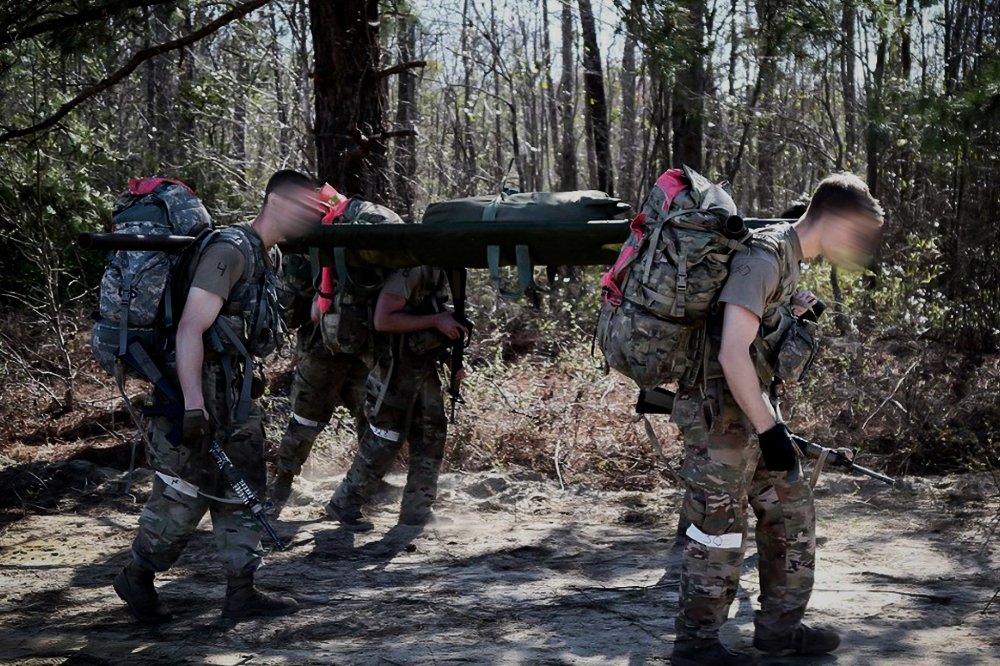
Fifty percent of the young Rangers who get an Option 40 contract don't make it to the Regiment.
Most of them were in shape. They trained off a dated plan, rumors from a buddy, or no plan at all. RASP showed them what a bad idea that was. The Regiment's own prep guide is a good conditioning plan for Pre-RASP. It was never meant to be your whole preparation.
Shut Up and RASP is the rest of it. Dr. David Walton, a retired Special Forces officer and career researcher, built this program from the current RPAT and RFT standards and the peer-reviewed literature. Cut through all of the rumors and guessing and get a plan that works. The goal isn't to scrape past the standard. It's to arrive with reserve capacity, so that when RASP spends weeks taking things from you, there's still something left for you to give.
Inside:
A 24-week program in three phases, with a Development track for the undertrained and a Selection track for the ready
Readiness gates, so your Week 2 depends on how you assess
Progressive running and rucking built on Zone 2 and the 10% rule
Strength, grip and power work aimed at the rope, the drag, the ladder, and the wall
The 5x5 Man Maker, a run, ruck and work-capacity session that will tell you the truth
Mobility, injury prevention, sleep, recovery and nutrition protocols
Skills, water confidence, and mental durability training
A complete performance journal, so you can track every session and see your progress
Rangers eat their young. Show up ready to feast.